Albania Property Revaluation in 2026: What Owners Should Check
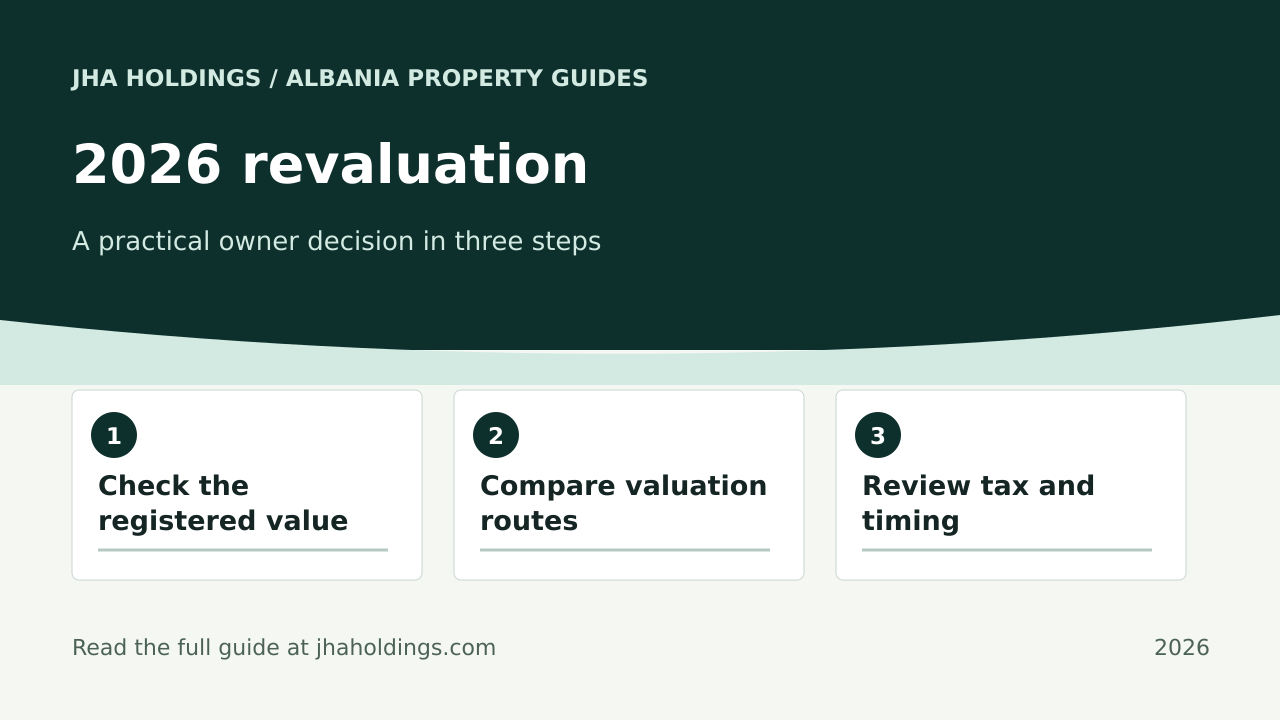
Albania's 2026 property revaluation programme is relevant to owners considering a future sale, estate plan, or correction of an old registered value. It is not a reason to assume that every property should be revalued. First establish the value currently recorded for the exact cadastral unit, then ask what a new basis would change for your own circumstances.
What the official announcement says
The State Cadastre Agency's February 2026 announcement says owners can apply through e-Albania through 31 December 2026 under Law 85/2025. It describes two valuation routes: a licensed property valuer or the local cadastre directorate using applicable reference prices. ASHK describes the revaluation tax as 5% of the difference between the revalued amount and the deductible value from the last registered act. These are the agency's published programme terms, not a calculation for your property.
Build the decision file before applying
Ask for the latest property card, the last registered acquisition or revaluation act, and any supporting documents for the amount currently recorded. Confirm the cadastral zone and property number; a flat, parking place, and land share may not all be the same registered asset. Ask a licensed valuer what is included in a proposed value and which comparable evidence was used. Have an Albanian tax or legal adviser check the consequences of acting now versus later, especially if ownership history, inheritance, or a pending sale complicates the record.
A useful example, not a tax quote
If a recorded deductible value were ALL 8 million and a valid revalued amount were ALL 12 million, the illustrative difference would be ALL 4 million. Applying the announced 5% to that difference gives ALL 200,000 before any case-specific adjustments or service costs. Do not transfer this example to a real transaction without checking the official calculation and documents.
What JHA can and cannot do
We can help an overseas owner organise copies, property identifiers, access for a valuer, and the post-decision property file. A licensed valuer, notary, lawyer, or tax adviser should determine eligibility and the financial effect. Our title and cadastre checklist is the logical first read if the registered asset itself is unclear.
Source and review: ASHK announcement and implementing-instruction index, reviewed 2026-10-08. Programme terms can change; confirm them before filing.